
Over the past two decades, I have inhabited many roles in relation to Arabic—learner, teacher, researcher, and curriculum developer. The question “Why is it important to study Arabic?” has been a recurrent one during my journey. The simple response is that the answer depends on the questioner. For some, the value lies in religious goals; for others, it lies in heritage, academic ambitions, or even politicized motivations. In reality, there is an answer—and an Arabic—for everyone.
So when I was approached to write this piece, I first asked myself who was asking the question. Why might it be important for an audience of Muslim women living in the twenty-first century to study Arabic? Serendipitously, I had already asked this audience this question. A few years ago, I conducted a research study with a number of women who were engaged in the pursuit of Islamic knowledge about their views of and experiences with the Arabic language. These women, 20 in number, were aged between 23 and 45 and ranged in their level of Arabic knowledge from beginner to fluent. They hailed from varying ethnicities and were engaged in a variety of professions. I interviewed each of them in-depth, and, if they’re reading, I’d like to thank them again here for giving up their time to do this!
In these interviews, the topic I was most interested in was the perceived role of Arabic in relation to religious literacy. Literacy is an interesting term. The word has undergone what linguists call “semantic drift,” whereby the meaning of a word evolves, leading to usage often significantly different from its original meaning. Derived from the Latin littera, the term “literate” was originally used to denote someone who was educated, instructed, or learned. By the nineteenth century, the meaning of “literacy” had narrowed. When defining it today, we might think of reading and writing skills—the ability to produce and access the written word. The National Literacy Trust defines it as follows: “Literacy is the ability to read, write, speak, and listen well. A literate person is able to communicate effectively with others and to understand written information” (National Literacy Trust, 2017). In contemporary usage, we might even think of literacy as synonymous with “skills” or “competence”—consider the use of the term “digital literacy” (the ability to use digital tools) or growing references to people as “AI-literate.”
Interestingly, Arabic has no direct parallel to this modern definition of “literacy” as relating to reading and writing skills. Rather, dictionaries (and Google Translate), render the term as thaqāfa, usually understood to mean “culture.” A person who is “literate” might be referred to as muta’allim, meaning “educated,” highlighting the historic link between literacy and knowledge, rather than just technical reading skills.
In the field of education, discussions surrounding the definition and application of “literacy” skills have given birth to a proliferation of terms and branches. Beyond basic literacy skills, the concept has expanded to include deeper dimensions, ranging from “functional literacy,” described by Lawton and Gordon as “the level of skill in reading and writing that any individual needs in order to cope with adult life” (1996, p. 108), to Freire’s (1972) “critical literacy,” whereby literacy becomes a means of liberation from hegemonic powers—a means to unpack ‘“myths and distortions and build new ways of knowing and acting upon the world” (Luke, 2014, p. 22).
The Role of Arabic in Religious Literacy
What do we mean, then, when we talk about religious literacy? And what role, if any, does Arabic play in its acquisition and application? To answer these questions, I analyzed the interview responses, and from these a framework emerged in which Arabic supports religious literacy through four interconnected dimensions: access, autonomy, agency, and authority.
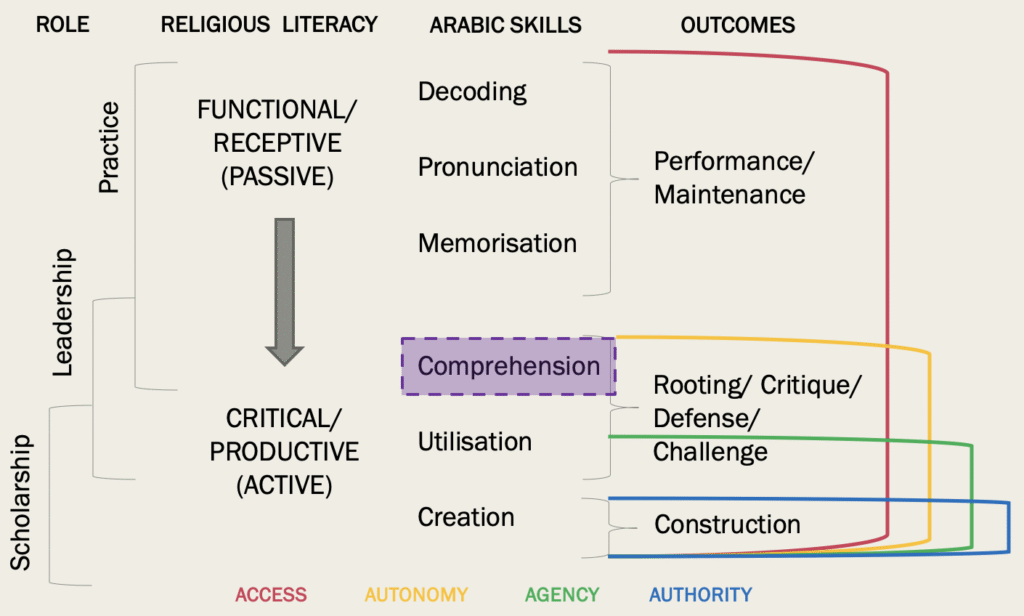
According to this framework, religious literacy can be envisioned as a spectrum from functional to critical religious literacy. In this context, a functionally literate individual can fulfil basic religious functions and engage in religious practice. Moving along the spectrum, we approach critical religious literacy. This would involve the ability to engage constructively with religion—in line with Freire’s approach, literacy here is a means to unpack myths and distortions and inhabit new ways of acting upon the world. Arabic language skills are closely tied to this spectrum, and as we move along these two interlinked trajectories, different levels of religious literacy are gained and different opportunities become available.
At the functional end of religious literacy, a person would need to memorize and reproduce Arabic words to perform sacred duties. This level also includes the ability to phonetically decode (read aloud without understanding) the Arabic script in order to read from the Quran. This level of Arabic facilitates the performance and maintenance of a religious Muslim identity, and allows access to religious communities, identities, and spaces, and can indeed enhance a feeling of spiritual connection. This is not to say, as one participant pointed out, that without Arabic one cannot have “strong faith”—faith arguably transcends language. But at the very least, to perform the five daily prayers, the majority of Muslims would agree some basic knowledge of Arabic is needed.
To move along the spectrum toward more critical religious literacy, higher-level Arabic skills are needed. Comprehension is the next milestone (although comprehension itself is a spectrum!). Comprehension of Arabic permits increasing access to the meaning of sacred texts and primary sources, as a result of which a degree of religious autonomy is achieved. Increasing levels of comprehension reduce dependence on translations and intermediaries to religious sources, allowing Muslim women to build their own independent religious understandings. As one participant put it, “religious literacy for me is linked to the concept of religious independence; being able to develop a religious understanding that is not solely taken from others but that can also be interpreted personally.” The dangers of a lack of autonomy were highlighted by another: “People can tell you what they want to tell you is in the Quran, and you have no way of verifying if you don’t have the language skills to at least look it up.”
Beyond comprehension (though inherently linked to it) are the skills of production or utilization: the ability to use, critique, and create Arabic output. The ability to interact with and in Arabic facilitates increasing levels of agency—with this level of Arabic, women can act on knowledge, using it in practice, defending beliefs, and teaching others. According to the women in the interview, knowledge of Arabic is seen as a form of religious capital, lending a person religious authority. One participant described it as a “cosignature,” of the type you might need in a bank—a stamp of legitimacy. As one participant mentioned, “if someone speaks Arabic, the assumption is that they must know a lot about the Quran and must be very religious.”
There is a dark side to the equation that Muslim identity + Arabic = religious authority. Arabic is not a monolith—and nor are all Arabics the same. Knowledge of Arabic as a first language often entails knowledge of an Arabic dialect. Arabic dialects differ from both Modern Standard Arabic and the Classical Arabic of the Quran at the syntactic, lexical, phonological, and morphological levels. While knowledge of an Arabic dialect, in some respects, may be an advantage in learning Classical Arabic, it does not guarantee comprehension of sacred texts. Without one’s own knowledge of Arabic, ascertaining another’s level of the language is nearly impossible, and thus the delegation of religious authority can often be misplaced.
At this point along the spectrum, equipped with access, autonomy, agency, and increasing authority, positions of leadership and opportunities for the creation of change become increasingly possible. At the furthest end of the religious literacy spectrum, according to this study, lies scholarship. This epitomizes the acquisition of critical religious literacy, as we are defining it here—the ability to build new ways of knowing and acting upon the world. The world itself is changing at a rapid pace—with every passing year, we are challenged to find, adopt, or accept new ways of knowing and acting in the world. The realm of religion is no different. While the core of what we want to know remains the same, and the centrality of Prophetic ethics is timeless, how we know this, and how we challenge the myths and distortions around beliefs and practices can and should develop. Scholarship—facilitated by access and the ability to interact with primary texts in their original Arabic—lays out a path via which inherited knowledge can be preserved but also revisited and expanded. In doing so, scholarship becomes the highest expression of critical religious literacy: a means of engaging deeply with tradition while also shaping its future application for changing times.
So why is Arabic important to Muslim women living in the twenty-first century? Because it equips us with the ability to move along this spectrum of religious literacy. Increasing levels of Arabic endow religious individuals with increasing levels of access, autonomy, agency, and authority, allowing us to inhabit different roles within religious life—from worship to leadership and scholarship. This spectrum is not a prescription; it is not necessarily the imposition of a specific destination but a map. The level of Arabic a person pursues will depend on the level of religious literacy they wish to achieve. In all cases, however, the importance of Arabic lies in its role in equipping each individual to navigate her own path along this journey.
References:
Freire, Paulo. 1972. Pedagogy of the Oppressed. Herder and Herder.
Lawton, Denis, and Peter Gordon. 1996. Dictionary of Education. Hodder and Stoughton.
Luke, Allan. 2014. “Defining Critical Literacy.” In Moving Critical Literacies Forward: A New Look at Praxis Across Contexts, edited by J. Zacher Pandya and J. Avila. Routledge/Taylor and Francis.
National Literacy Trust. 2017. What is Literacy? Accessed online: https://literacytrust.org.uk/information/what-is-literacy/.
Written by Anse Dr. Anna-Maria Ramezanzadeh, Ribaat Academic Institute