
Introduction
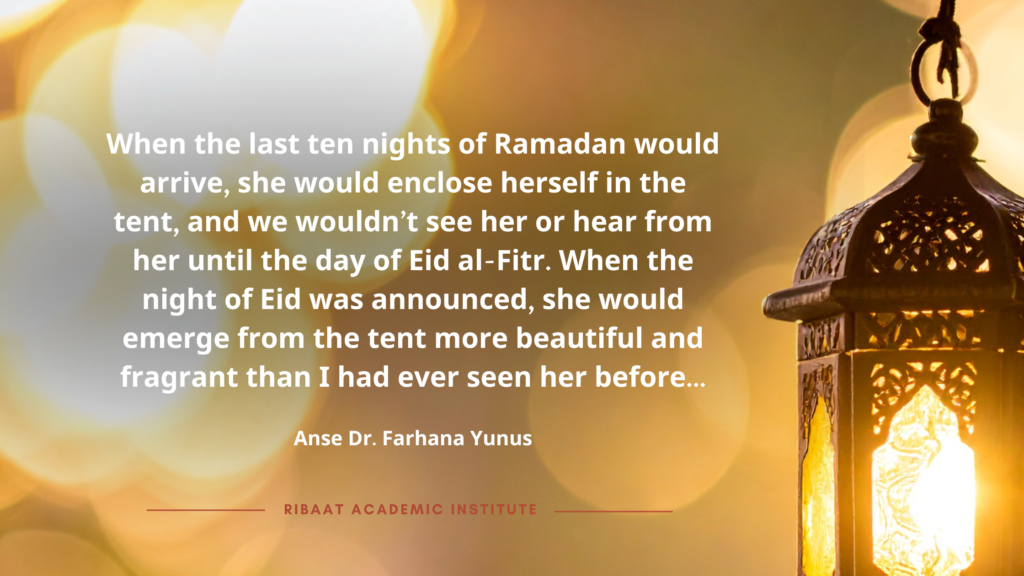
My first experience with iʿtikaf was very different from most people. My grandmother, may Allah have mercy on her, would go into iʿtikaf every year in the last ten nights of Ramadan. She would spend the first part of Ramadan sewing a cloth tent out of a beautiful, simple, delicate, breathable material. Inside, she would put a soft prayer carpet, her masbaha or dhikr beads, and mushaf (Quran). When the last ten nights of Ramadan would arrive, she would enclose herself in the tent, and we wouldn’t see her or hear from her until the day of Eid al-Fitr. When the night of Eid was announced, she would emerge from the tent more beautiful and fragrant than I had ever seen her before, and we would adorn her with necklaces of roses that we had made and give her special sweets, all the while congratulating her. Although I didn’t know what it meant at the time, I knew it was something very special, and something to be celebrated.
What Is Iʿtikaf?
Iʿtikaf is spiritual and physical seclusion with Allah ﷻ. Before the Prophet ﷺ received revelation, part of the preparation was his ﷺ love for seclusion. He used to go to the cave of Hira’ for extended periods of time. These were moments that were critical to the development of the Prophet ﷺ. In our time, most people understand iʿtikaf to mean seclusion in the masjid in the last ten nights of Ramadan. This is definitely a sunna of the Prophet ﷺ and a sunna he ﷺ didn’t skip. Aisha (radiya Allahu ʿanha) said, “The Prophet ﷺ used to practice iʿtikaf in the last ten days of Ramadan till he died, and then his wives used to practice iʿtikaf after him” (Sahih al-Bukhari). Iʿtikaf can be seclusion in worship at any time; it isn’t limited to Ramadan or just the last ten nights.
Iʿtikaf is an act of devotion where you commit yourself to the worship of Allah. When performed in Ramadan, it involves fasting, limiting interactions with people, and abstaining from sexual relations. Iʿtikaf for men is valid only in the masjid, but women can perform it in the masjid or preferably at home. There are only two conditions necessary for the iʿtikaf to be valid. The first is the intention, which should be made by men before entering the masjid, and for women at home, before they step onto their prayer carpet or enter their iʿtikaf space. The second is to not be in a state of major ritual impurity. Your iʿtikaf ends when you leave the masjid or leave your prayer area if you are home.
What to Do in Iʿtikaf
When you begin iʿtikaf, it is important to make your intention for Allah alone. Look deep in your heart and make sure that this beautiful act of worship is not intended for any other purpose than closeness to Allah ﷻ and His love. Devote your entire time in solitude to being present with Allah in dhikr, salah, Quran recitation, and dua. Make an extensive dua list with all your “impossible” duas, and dream big. You want to make sure to spend the nights in qiyam al-layl. You—with all of your needs and wants—are with the One who loves to give. You can make up any qaḍāʾ or missed prayers you may have. You can include different nawafil salah, like Salat al-Haja and Salat al-Tasabih. You can read beneficial books or listen to beneficial lectures about Allah ﷻ and His Messenger ﷺ. Drown yourself in the remembrance and closeness of Allah. The great scholar Ibn al-Qayyim al-Jawziyya said, “The soundness of the heart and its ability to stay firm in its journey to Allah is dependent on its ability to fully focus on Allah. The heart has a restlessness that can only be removed by devoting oneself to Allah. Excessive food, drink, socializing, sleep, and talking increase the restlessness of the heart. They hinder the seeker from the path in their journey to Allah, and weaken them.” I like to say this spot in the heart is like a USB port, and only knowing or loving Allah alone can fit there and calm the restlessness of the heart. Oftentimes, we try to charge this port with other mismatched chargers, only resulting in more restlessness.
Benefits of Iʿtikaf
One of the beautiful benefits of iʿtikaf is that you taste the sweetness of conversing intimately with Allah. You are truly in the best of company; you are home. You also get to look deep in your heart, observe the diseases that have consumed it, and begin the beautiful purification process so that your soul can elevate and rise to the higher stations, and you can truly become the person of Janna that you are meant to be. A part of that is reflecting on the sins you have been committing and ignoring, or even the heedlessness of forgetting Allah. This puts you in a space of sincere repentance with no distractions. You can now develop a deeper level of sabr and ikhlas in worship. ʿAli ibn Husayn (radiya Allahu ʿanhu) narrates from his father that the Prophet ﷺ said, “He who observes the ten days iʿtikaf during Ramadan will obtain the reward of performing hajj twice and performing ʿumra twice” (al-Bayhaqi). ʿAbdullah ibn ʿAbbas (radiya Allahu ʿanhu) reported that the Prophet ﷺ said: “Whosoever for Allah’s sake did even one day of i’tikaf, Allah ﷻ will keep them away from Jahannam by trenches” (al-Tabarani). Finally, Ibn ʿAbbas (radiya Allahu ʿanhum) reported that the Prophet ﷺ said about the one who engages in i’tikaf that “they are safe from sin and also get the reward that everyone [outside of i’tikaf] gets for pious deeds” (Ibn Maja).
Conclusion
I’tikaf is an invitation to spiritual intimate seclusion with your beloved Creator. This Ramadan, take the time to claim it, whether it’s the full last ten days or for a few hours in a day. The heart longs for this closeness, and with the distractions of social media and the world, we rarely get to experience such deep closeness with the Divine. The rewards are immense, and the effects last a lifetime. As I approach Ramadan, I will purchase and wash special prayer clothes, a special new scented prayer carpet, find a secluded part of my house, have dhikr beads and dua books at the ready, and prepare my beautiful love letter from Allah—a mushaf (Quran)—on a stand ready to be recited. I will make dua for my grandmother and remember her deep love for the Prophet ﷺ and for following his ﷺ sunna in iʿtikaf.
Anse Dr. Farhana Yunus, Ribaat Academic Institute Instructor
Bibliography
Aisha. “Seclusion with My Lord: My First Home I’tikaf Experience.” Deenspiration (blog), June 16, 2019. https://deenspiration.com/my-first-itikaf-experience/.
Ali, Zakeeya. “A Simple Guide to I’tikaf (Spiritual Retreat) for Women.” Zakeeya Ali (blog), April 21, 2021. https://www.zakeeyaali.com/blog/itikaf-for-a-muslim
Islamic Society of Boston Cultural Center. “The Virtues of I’tikaf.” ISBCC (blog), June 17, 2017. https://isbcc.org/the-virtues-of-itikaf/.
Life with Allah. “I’tikaf: The Sweetness of Solitude.” Life with Allah (blog), March 29, 2024. https://lifewithallah.com/articles/seasons-of-worship/ramadan/itikaf-the-sweetness-of-sollitude/.
_______
1 Aisha, “Seclusion with My Lord: My First Home I’tikaf Experience,” Deenspiration (blog), June 16, 2019, https://deenspiration.com/my-first-itikaf-experience/.
2 Zakeeya Ali, “A Simple Guide to I’tikaf (Spiritual Retreat) for Women,” Zakeeya Ali (blog), April 21, 2021, https://www.zakeeyaali.com/blog/itikaf-for-a-muslim.
3 Ali, “Simple Guide to I’tikaf.”
4 Life with Allah, “Iʿtikaf: The Sweetness of Solitude,” Life With Allah (blog), March 29, 2024, https://lifewithallah.com/articles/seasons-of-worship/ramadan/itikaf-the-sweetness-of-solitude/.
5 Life with Allah, “Iʿtikaf.”
6Life with Allah, “Iʿtikaf.”
7 Islamic Society of Boston Cultural Center, “The Virtues of I’tikaf,” ISBCC (blog), June 17, 2017, https://isbcc.org/the-virtues-of-itikaf/.
8 Islamic Society of Boston, “Virtues of I’tikaf.”
9 Islamic Society of Boston, “Virtues of I’tikaf.”