
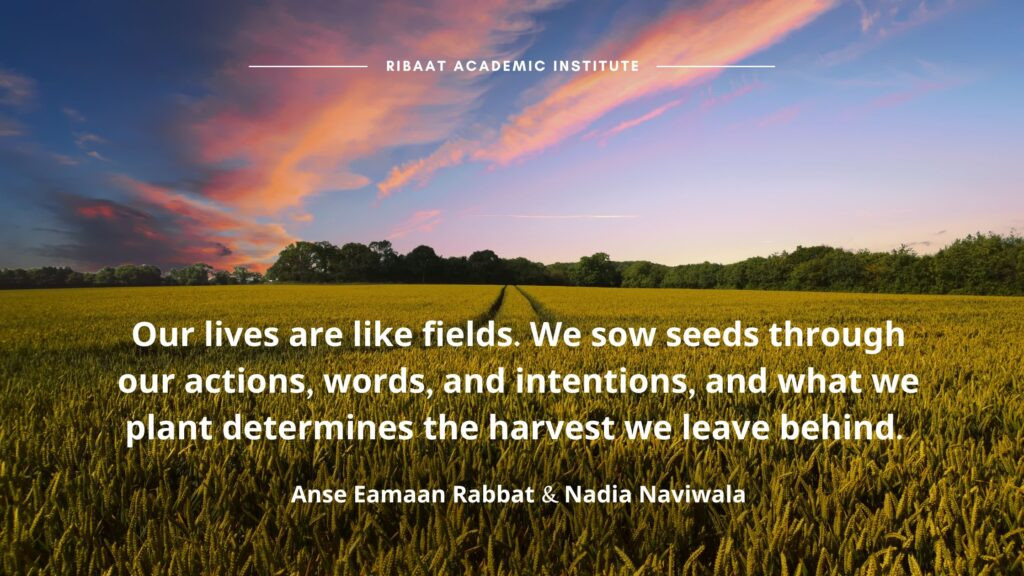
Our lives are like fields. We sow seeds through our actions, words, and intentions, and what we plant determines the harvest we leave behind. What will my legacy be? The Prophet ﷺ taught us that when a person dies, their deeds come to an end—except for three: sadaqa jariya (continuous charity), knowledge that is beneficial, and the prayers of a virtuous descendant. In a world where so much fades, possessions break, money is spent, and accomplishments are forgotten, these three legacies endure, continuing to send blessings to the believer even after they have returned to Allah. If you are able to produce knowledge and share this knowledge, please do so. If you can publish a book, then do it, but if not, teach something. Create a video. This will stay for you as long as people are benefitting from it. You will continue reaping the benefit from this harvest.
Charity that lives beyond us might be a well that quenches generations, a school that enlightens countless students, or even a single book donated to a library. Knowledge, too, is a harvest that never stops giving. It is not only the domain of scholars and authors; each of us can plant seeds of knowledge. Teaching a child a verse of the Quran, sharing a prophetic saying with a friend, explaining a lesson that shaped us—these are all ways of planting what will outlive us.
The companions of the Prophet ﷺ understood this truth deeply. Some, like Ibn ‘Abbas (may Allah be pleased with him), traveled months just to hear a single hadith, preserving and transmitting knowledge so it would reach us centuries later. Today, we can access entire libraries in seconds, a blessing that calls for gratitude and effort. But true knowledge is not about collecting quick answers online. Like any real harvest, it requires planting, tending, and patience. A ruling or a piece of wisdom has deep roots in study, context, and reflection, just as a sunflower’s beauty hides years of growth and its subtle unique qualities, like how it turns to the sun.
This is the vision behind Rabata. When Anse Dr. Tamara Gray studied in Syria, she entered a long tradition of women scholars who carefully preserved sacred knowledge. Returning to America, she found women still yearning for that knowledge. Out of that yearning, Rabata was born: translating curricula and making knowledge accessible in English, and planting seeds of scholarship across the globe. This is harvesting knowledge—taking the roots of tradition and making them flourish for our time.
Learning is not limited by age or circumstance. Whether you are in your twenties navigating school, in your middle age managing work and family, or in your older years with quieter days, there is always more to learn. Even a page a week or a single class can be part of your harvest. Sometimes what we gather doesn’t seem useful right away, like multiplication tables memorized in childhood, but in moments of need, it becomes sustenance, just like stored crops during winter.
And knowledge is not just for ourselves. A prayer whispered in public, a hadith shared with a neighbor, an encouragement to sign up for a class—each of these small acts can spark transformations we may never witness. Like seeds carried on the wind, the knowledge we share can sprout in unseen soil.
But effort is required. Just as seeds need water and sunlight, learning requires persistence. Online classes, books, or study circles may feel difficult to keep up with, yet even partial effort is never wasted. Seventy-five percent of a class completed is still seventy-five percent more than you knew before. Growth doesn’t demand perfection, only consistency.
Underlying all of this is intention. Two people can perform the same act, but only the one who does it for Allah’s sake reaps eternal reward. Knowledge sought with sincerity raises rank, for Allah tells us that true honor belongs to those who learn. The Prophet ﷺ said to ‘Ali (may Allah be pleased with him), “By Allah, if a single person is guided by Allah through you, it will be better for you than a whole lot of red camels.” Help someone come to Islam, and this is not always converting someone. We want to guide someone to Islam through Islam. The red camel here is like the best car you can have, or even like a private jet. Share the knowledge you know with one person, and that will be better than anything else you can own in this life!
Knowledge is the path to Paradise. We have heard these hadith over and over, and everyone is looking for the path to Jannah. We all want the quick ticket, and here it is: Start learning. Number one, you are learning. Inshallah what you learn, you will apply, and this will guide you to Paradise. Number two, you are spending your time in the way of Allah, instead of spending your time doing something else, and that time will lead you to Paradise. And number three, you get a reward for every word and every letter you learn, and that will all be added to your scales. That’s the formula.
Allah swore by the pen and what it writes. The very first command was “Read.” And in the Quran, we are taught to pray: “My Lord, increase me in knowledge” (20:114). This is a divine invitation, a reminder that every step taken on the path of learning is a step toward Paradise.
So we must ask: How can we reap the benefits of learning? Intention, linking that knowledge with action, benefitting others, continuing in lifelong learning, cultivating humility in ourselves, and integrating our heart, mind, and spirit. Share something. Benefit someone. Abdullah Ibn Mas’ud (may Allah be pleased with him) reported: I heard the Messenger of Allah ﷺ saying, “May Allah make radiant the face of a person who hears something from us and communicates it to others exactly as he has heard it, for it may be that the recipient of knowledge understands it better than the one who has heard it (Jami’ al-Tirmidhi).
So let us take a moment to reflect on what kind of harvest we are building and leaving behind as our legacy. Are we planting seeds of charity that will shade others? Are we sharing knowledge that ripples outward? Are we raising children and a next generation who will carry our names in their prayers? Life is brief—like a passing shadow, a single breath. But within it lies the chance to plant seeds, the fruits of which never end.
May Allah make us among those whose books of deeds remain open, whose harvest continues to grow, and whose legacy is one of light. Ameen.
____
1 https://sunnah.com/riyadussalihin:1383
2 https://sunnah.com/riyadussalihin:1379
3 https://sunnah.com/riyadussalihin:1389
____
Anse Eamaan Rabbat (Education Director) and Anse Nadia Naviwala (Education Director Executive Assistant), Ribaat Academic Institute